What is a wellbeing business?
Most businesses ask: how much profit did we make? A wellbeing business asks something different: are people and ecosystems thriving?
That single question reorients everything — purpose, governance, operations, and how success is measured.
A wellbeing business is not simply a company with a CSR policy or a sustainability report. It is an enterprise built from the ground up around the flourishing of everyone it touches: employees, customers, communities, and the natural world. Profit matters, but it is a means, not the mission.
What makes a business a wellbeing business?
At its core, it starts with a different worldview. Whether rooted in wellbeing economics, Hinduism, Buddhist philosophy, or indigenous ways of knowing like Māori thought, a wellbeing business understands that human and ecological health are inseparable from long-term value creation.
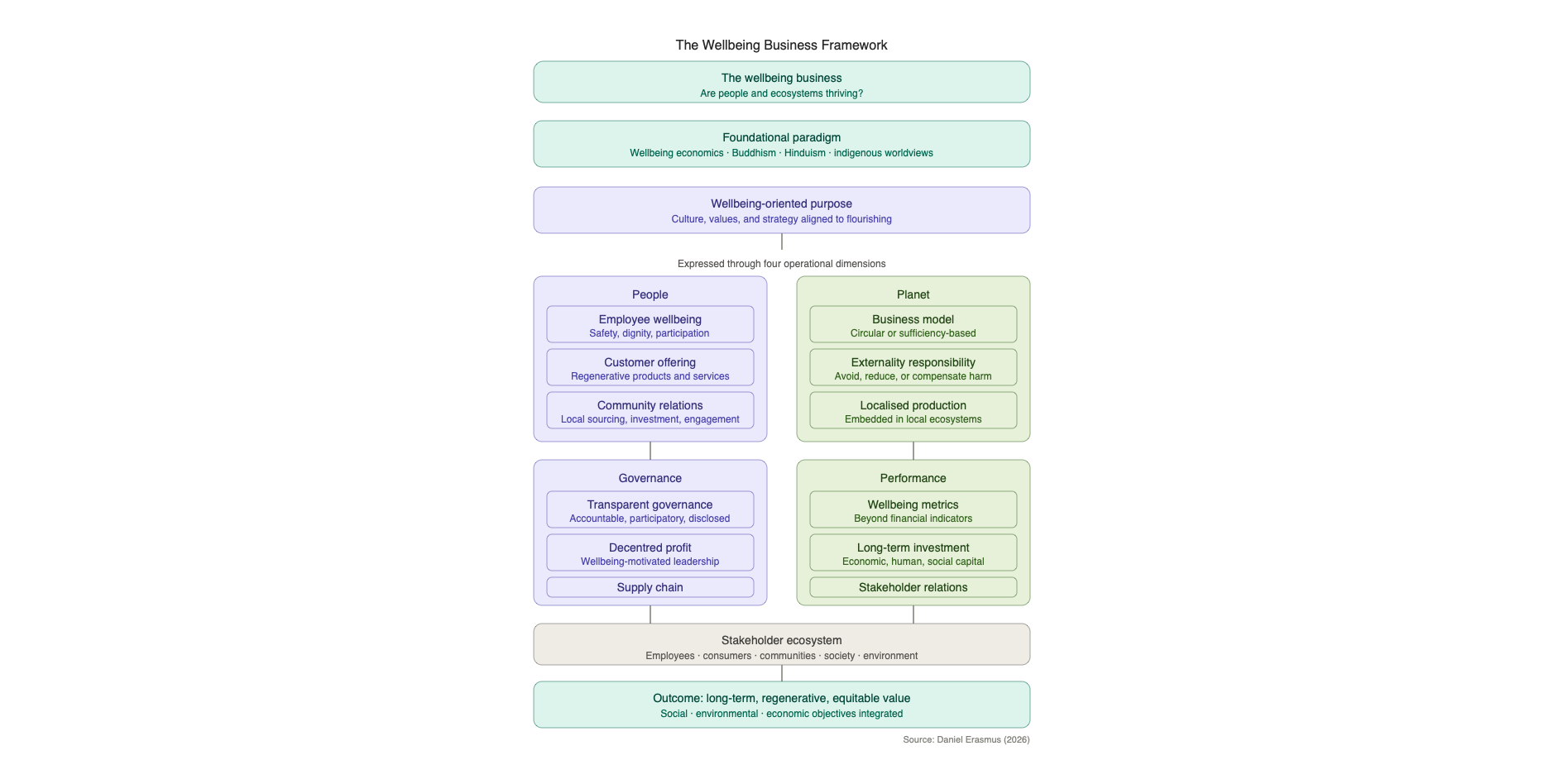
This philosophy shapes four operational dimensions:
-
People — employees experience psychological safety, dignified work, and genuine participation. Customers receive products and services designed to improve lives, not just satisfy demand.
-
Planet — the business adopts circular or sufficiency-based models, takes responsibility for its negative externalities, and embeds itself within local ecosystems rather than extracting from them.
-
Governance — leadership is transparent, accountable, and collective. Short-term profit maximisation is decentred in favour of decisions that serve the whole stakeholder system.
-
Performance — success is measured in wellbeing outcomes across all stakeholders, not financial returns alone.
To capture what a wellbeing business is I developed the Wellbeing Business Framework below (double-click to zoom in).
Why does it matter?
The conventional business model externalises harm — to workers, communities, and the environment — in pursuit of shareholder value. A wellbeing business internalises responsibility instead. It asks whether its supply chains are non-extractive, whether its communities are better off, and whether the ecosystems it depends on are being regenerated.
It is, in short, a business designed for a world worth living in.